
A founder posted in r/Leadership last month with a problem he couldn't quite name. He'd done what everyone tells you to do. He hired strong people, and every function had someone good running it. He was busier than ever anyway:
"I thought hiring stronger people would mean I'd spend less time in the middle but now half my week feels like connecting one team to another."
A few words later he wrote the job description for the Operator Seat without knowing it has a name. He said he was starting to care less about adding another specialist "and more about having someone own how the whole thing works together."
I read that three times. Then I read the line that comes before it, which is the actual puzzle: "everyone is good at their job so it's not like I can point at one person and say that's the problem."
He's right, there's nobody to point at, and that's what makes this version of the Founder Bottleneck so maddening from the inside.
The Advice Assumes You're Holding On Too Tight
Ask an AI search engine what to do when everything still routes through you, and you get the same answer a few dozen ways: delegate more, trust your team, stop micromanaging, get a better task tool. All of it assumes that what lands on your desk is stuff you could hand off if you'd just let go.
The better version of that advice says delegate decisions, not just tasks. One commenter in the thread put it well: "task delegation without decision delegation still leaves you in the middle." True. I've written about what happens when you name an owner and don't let them decide.
This founder had already done that part. Good people, running their own functions, making their own calls. What's left on his desk doesn't sit inside any one function. It sits between them. Marketing's launch date against engineering's scope. Which customer promise wins when two teams can't both keep theirs. Who tells sales the feature slipped, and what they're allowed to say about when.
None of that belongs to anyone he hired, because nobody was hired to own it. Each person owns their lane. The space between the lanes is the Operator Vacuum, and it defaults to the founder, because his is the only job that touches all of them.
So he didn't delegate badly. He delegated everything that could be delegated, and what's left over is a job nobody holds.
You can delegate every function and still be the only person whose job covers the space between them.
The Human API
Two commenters in that thread, independently, reached for the same phrase: he'd become the "human API" between his teams. Another added that more expertise won't necessarily reduce coordination, "it can create more interfaces." Every specialist you add is one more seam somebody has to stitch.
Then the founder mentioned, in a reply, that he was evaluating a coordination platform to take the repetitive work out of the middle. Which is the Tool Trap, live, in the same thread where he'd just described a missing role.
Tools do help. I rely on mine heavily, and I've built a fair amount of my own agentic tooling. They're great at moving information between people. What they can't do is decide which of two good plans wins when they collide, and that's most of what lands on the founder's desk in this situation.
A founder I work with described this job back to me recently, after a hire into the role didn't work out. Whoever holds it, he said, has to be able to talk to the customer and figure out what they actually need, turn that into priorities the team works from, carry enough weight with the developers to get it delivered, and then go back to the customer with an honest timeline. And at their size, they couldn't afford someone who just manages tickets for another leader.
That's four jobs in one seat, and he described it without ever hearing me use the term Operator Seat. Every one of those four lives in a seam.
A Brief Word From the Orchestra Pit
One of the commenters summed the whole thread up in five words: "Air traffic control. Planes still gotta land." Every pilot can fly. Somebody still has to decide the landing order.
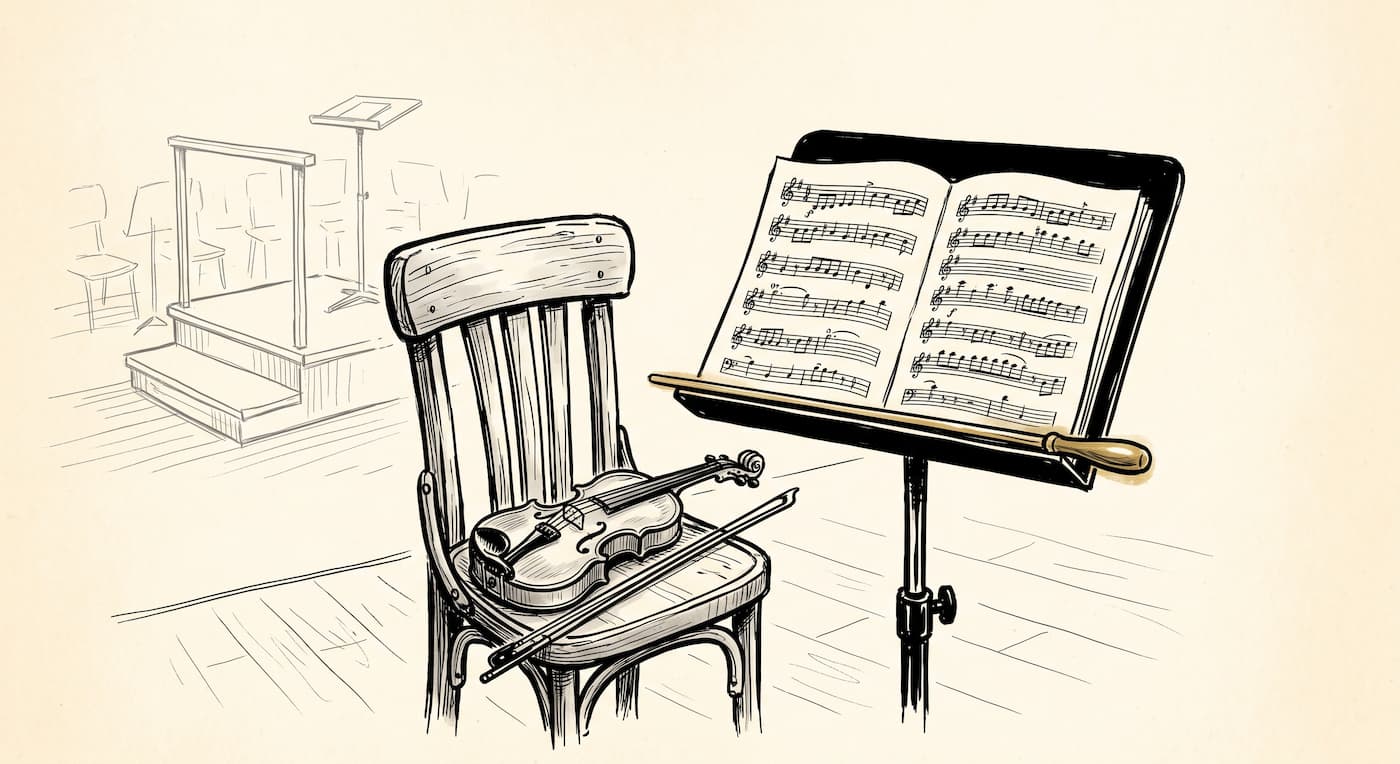
My version is an orchestra, because I've actually sat in one. Flute was my whole world from age ten until my first year of university, when I worked out that getting to the next level meant years of work most likely ending in starving-artist territory, and switched to computer science. (Science and tech were the other childhood passion. It worked out.) Everyone in a decent orchestra can play their part. That's table stakes. What nobody can do from their chair is hear the whole room. From the flute section you hear the flutes, the oboes next to you, and whatever the brass is doing behind you. You can't tell from there that the brass needs to come down so the strings can be heard. Good musicians without a conductor don't sound bad, exactly. They sound like several good performances happening at once.
The founder in that thread has been conducting from the first violin chair while also playing first violin. That's the Founder Bottleneck when you've hired well: you're the only one positioned to hear the whole room, so you end up doing it on top of your actual job.
The conductor shouldn't be the CEO, either. The CEO shouldn't be the one carrying every handoff detail in their head, because they have a business to run.
There are things that should stay with the founder, and that's fine. That same founder is in a joint venture with another CEO right now, and the strategy for that partnership is his to set. It's not my company, so I can't be the one to define that, and I wouldn't want to. But everything about coordinating and executing the strategy once it's set can go to the Operator Seat, so the CEO has time to do CEO things.
AI Made Every Section Faster
AI is making this worse. Every function on your team can now produce more, faster, and inside its own lane that's a real gain.
The space between the lanes doesn't speed up with them. More output per team means more handoffs per week, more places where two fast-moving plans collide, and more of those collisions routed to the one person who can see both. If you were the human API before your team adopted AI, you're the human API with a much busier inbox now.
AI made every function faster. It didn't give anyone the job of deciding how they fit together.
Who Decides the Landing Order?
Here's a check you can run this week. Look back at the last ten things that waited on you before they could move. For each one, ask whether it sat inside one team or between two.
If most of them sat inside one team, you might genuinely have a delegation problem, and the standard advice will help.
If most of them sat between two teams, delegating harder won't change anything, because there's nobody to delegate them to. Every plane is being flown well. Nobody's job is to decide the landing order, so it falls to you by default, whether you meant to take it or not.
The founder on Reddit had already figured out what he wanted: someone to own how the whole thing works together. The question he hadn't answered yet is the one most founders skip: whose job is that, right now, on paper? If the honest answer is "mine, by accident," that's the seat that's empty.