
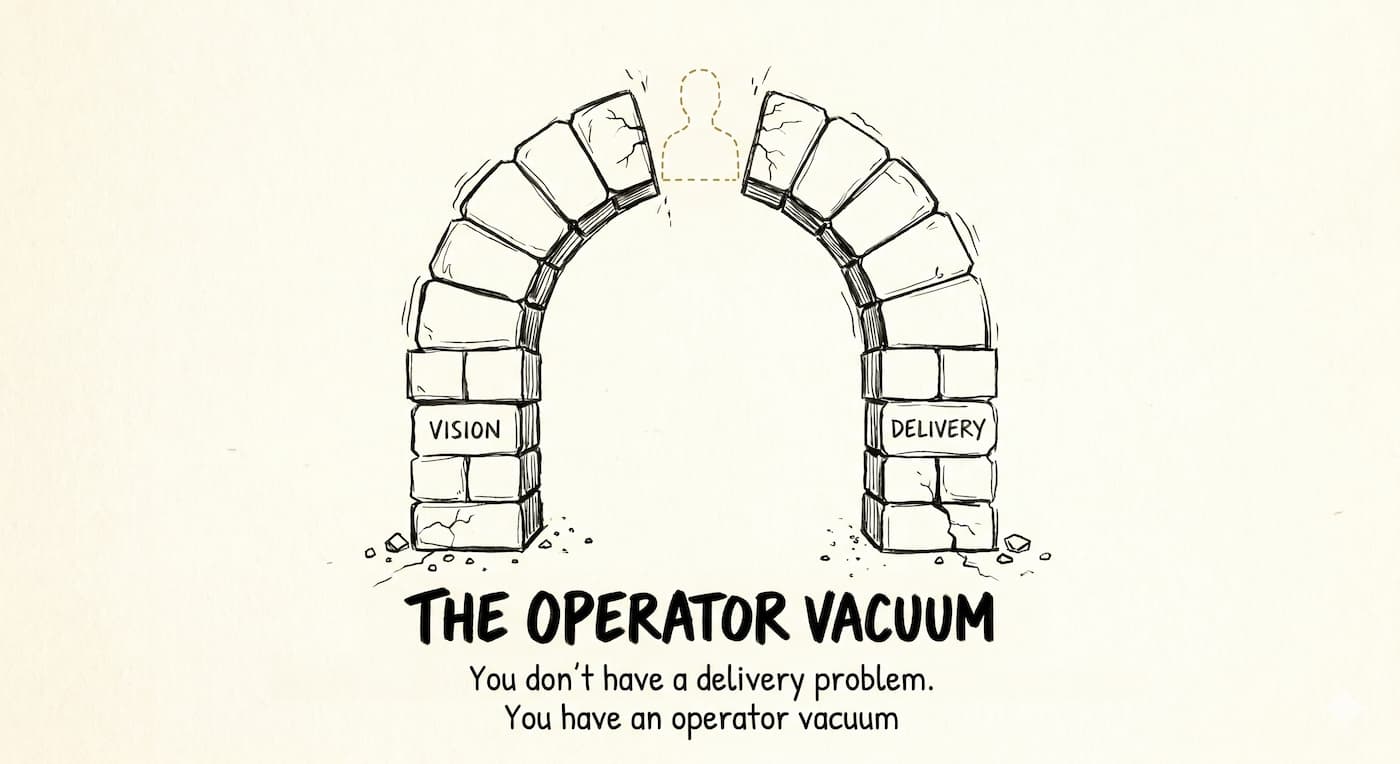
The problem shows up differently depending on the org. Sometimes the product isn't shipping and everyone knows it — you've run through the vendor, the PM, the process, sometimes all three, same result. Sometimes it's shipping and not doing anything: the sprint closed, the roadmap delivered, the metric didn't move. And sometimes it's shipping constantly and you still can't turn the corner. The team is running hard. Nothing is exactly wrong on paper, but it feels like a constant fire drill and everyone is on their last thread.
Three different presentations of the same structural gap.
I've had this conversation enough times to get to the point fast: there's a gap in your system that nobody owns. It's the space between what you're trying to build and what's actually getting shipped — where someone should be accountable for making sure those two things converge. It's empty. Nobody lives there.
That's the Operator Vacuum, and it's why the pattern keeps repeating.
Delivery is Just a Red Herring
The Operator Vacuum isn't strictly a delivery problem. It's a missing connective layer — the function of connecting your vision to what ships, end to end.
Most founders don't see it because the vacuum is invisible from inside. You can see the symptoms: slow delivery, a roadmap that keeps shifting without ever landing, decisions that should be made downstream landing on your desk instead. What you can't see is the cause — because the cause is an absence. There's no meeting, no artifact, no person pointing to it. It's the space where something should be happening and isn't.
The vacuum doesn't announce itself. It just keeps producing the same symptoms until you run out of things to blame.
The Hole in the Org Chart
I've seen this in enough different orgs to recognize it. Across different industries, company sizes, and org charts, it manifests a little differently each time.
At the smallest end: a founder who knows what needs to exist, an outsourced dev team that knows how to build things, but nobody is making sure those two are working from the same model. I've worked in exactly this setup. The vendor stayed in their lane — that's not incompetence, that's how vendor relationships work. My client knew his business logic cold but didn't know what he didn't know about the product layer. In between them was an entire category of questions nobody was asking: edge cases, unhappy paths, the parts of the product that only matter when something actually goes wrong in the field. No one was actually failing at their job. But there was no function responsible for asking the necessary questions.
The gap looks different in a more mature org, but the nature of it is the same. A CTO running engineering. A PM doing product research and building a roadmap. Marketing with their own roadmap. Customer success managing throughput and NPS. Everyone executing well within their function. But nobody is holding the system view that sits above all of it — the view that asks whether what engineering is building reflects what product research actually found, whether the marketing roadmap connects to the real product direction, whether the decisions being made across all these functions are adding up to something coherent.
The CEO should be holding that view, in theory. In practice: the CEO is running the company. Managing the board. Chasing revenue. Dealing with whatever just became urgent. In the early days, founders held both functions because the org was small enough that the gap was manageable enough that it didn't need to be named. Then the company grew. The gap widened. The person who used to fill it got pulled in 17 other directions. But nobody noticed, because there was never a job description to notice was missing.
The vacuum is scale-independent. It just wears different clothes in different situations.
Nobody posts a job description for the function that bridges strategy to ship. Which is probably why it remains unfilled.
The vacuum isn't created by bad people doing bad work. It's created by a structural gap that nobody thought to fill.
No Villains. Lots of Damage.
Time and money first. Every week the vacuum runs is a week of runway spent on effort that doesn't land. Every decision that should be made downstream but lands on the founder's desk instead is attention the founder doesn't have for the work only they can do. What didn't get built — or got built and didn't matter — while all of this was happening is a number most founders don't let themselves fully sit with.
Then there's what it does to the team.
Sometimes the damage is invisible because delivery is still happening. Sprints closing, deploys going out, roadmap progressing — the metrics say the system is functional. But ask anyone on the team how they're doing and you'll hear some version of the same thing: we're building and it's not turning into anything. Every sprint feels equally urgent. Nothing compounds into visible progress. The work is real, the output is real, and somehow they're no closer to the thing they're actually trying to do. That's a different shape of damage than delivery failure — it's exhaustion without a destination.
When delivery actually breaks, the lesson arrives differently. Sprint after sprint, the team learns that effort doesn't reliably produce outcomes. Not because they're bad at their jobs. Because the system is broken in a way nobody's named, let alone fixed.
They stop raising problems that don't get fixed. After enough sprints that go nowhere, they've done the math and the math says don't invest. I've watched founders describe this as "low buy-in" or "resistance to change." What they're describing is a team that stopped trusting the system. Not the same diagnosis.
I've sat in standups where the energy is so flat you can feel it. That flatness, the disengagement of a team that's stopped believing the work will land, doesn't start with conflict or drama. It starts with people doing the only rational thing: protect their energy.
Sometimes it stops there. Sometimes it doesn't.
I've also walked into situations where the frustration had been building long enough that it turned outward. The founder can't understand why nothing ships and responds with tighter control, even outbursts or rash decisions seemingly out of nowhere. The team reads that as a signal that raising problems isn't safe. So problems stop being raised. They compound in the background instead. The culture that was just stuck becomes something harder to fix — people careful about what they say, careful about who's in the room, doing the mental math before every honest conversation. Nobody designed this. The vacuum just ran long enough.
The trust that erodes in a sustained Operator Vacuum isn't lost through conflict or betrayal. It's lost through repetition. The team learns that effort and outcome are disconnected — and they adapt accordingly.
There's no villain in this story. That's what makes it so hard to see, and so hard to fix.
One Question Worth Asking
Here's the question I actually ask early in any new engagement:
When something goes wrong with delivery — who finds out first, and what do they do with that information?
If you have to think about it, or the answer is "it depends" — that's the vacuum telling on itself.
Most people pause when I ask. Some say "the founder." Some say "it depends on what went wrong." Both answers tell you the same thing.
When the seat is filled, there's someone whose job it is to know before anyone else does. They've already mapped the risk. They have a response forming before the founder hears about it. That's not heroics. That's just the function running.
When it isn't, the founder finds out at the worst possible moment, from the most stressed person on the team, with the fewest options left. I can usually tell within the first week of an engagement whether anyone's been playing that role. The answer is almost always no.
It's Fixable. Just Not the Way You've Been Trying.
The Operator Vacuum can be filled. But not by tools, not by adding a PM to the org chart, not by a better retro format. Those fix delivery problems. This isn't a delivery problem.
What fills it is someone who owns the outcome end to end — not a slice of it, not the reporting on it. The whole system, from vision to ship, with their name on it when it breaks.
I've talked to founders who've already tried most of the usual go-tos. Changed the vendor. Hired the PM. Ran better process. Each change felt like motion, and motion felt like progress. The vacuum was still there after all of it, because none of those changes addressed what was actually missing.
If you're still here after everything you've tried — that's what's missing. The only question is how long you keep looking somewhere else for it.