
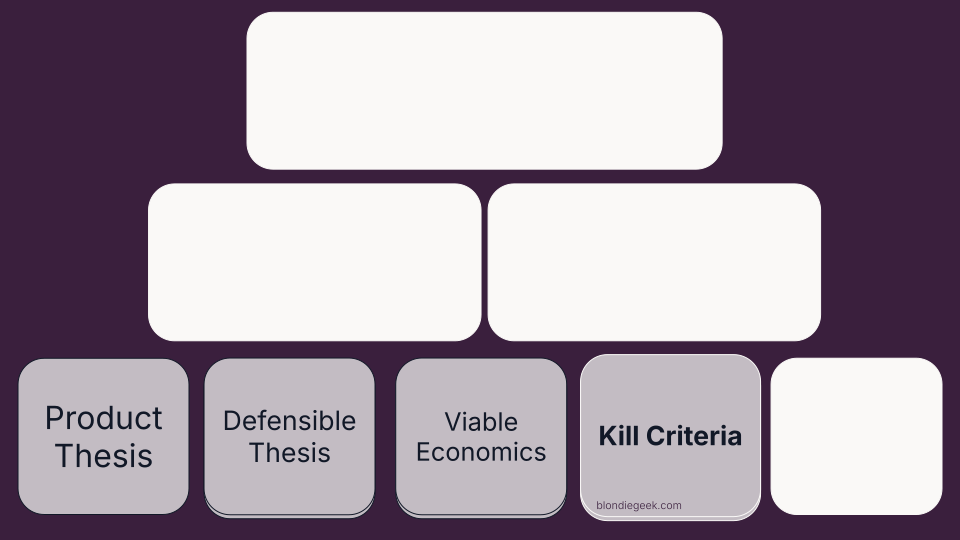
So far in the 0->1 product series, we’ve travelled this path:
- The importance of having a thesis
- Making that thesis defensible
- Sanity checking that your plan can realistically make money
This is the stage where everything feels like it’s lining up. And you’re probably developing an itchy trigger finger at this point. Your energy has likely shifted to
“Okay — let’s define the MVP and start building. Once we ship, we’ll finally have real signal.”
Totally reasonable. But this inflection point isn't actually about execution just yet. Now that you’re invested (in every way), it's really about objectivity.
Maybe it’s your savings. Maybe it’s friends and family money. Maybe you’ve already told investors and the team where this is going.
And not just invested financially - you’ve sunk countless hours and maybe even sleepless nights to get this far.
You’re not neutral anymore. From here on, it’s going to get harder to maintain objectivity, once this thing moves from a concept to out in the wild, a real, living, breathing thing.
And that’s exactly why most teams make their next decision with less objectivity than their last one.
“Begin with the end in mind” — but not the end you’re thinking of
One of Covey’s "7 Habits" that has always resonated most with me is “begin with the end in mind.”
Founders are actually pretty good at doing this — on the success side.
You define goals:
- “Get X users in Y months.”
- “Hit $X revenue by [date].”
- “Ship by [date] so we can show progress.”
Then you work backward into features.
What do we need to build for this to be minimal and viable?
That part is normal. Necessary, even. But there’s another half of “the end” that we often sort of gloss over - because, honestly, it can be anxiety-inducing to go down that path in our minds:
If we don’t hit those signals in that timeframe, this version of the bet doesn’t deserve more investment.
Guarding against our lizard brains
Founders don’t avoid kill criteria because they’re naïve, they avoid them because they’re committed.
By MVP stage, the idea isn’t just a hypothesis. It’s tied to identity, credibility, and sunk cost. At this stage, almost any movement can be framed as progress.
Some signups → “There’s demand.”
A few passionate users → “We’re onto something.”
A spike after a release → “It’s starting to click.”
And when early signals are weak or mixed, it’s not unusual to interpret this signal through a less-than-objective lens:
“We just need a few more features.”
“Users don’t fully see the value yet.”
“A big break is just around the corner.”
This feels like perseverance. It’s usually the start of a slippery slope that leads to throwing good money after bad. The bar for “working” keeps sliding. Every ambiguous signal gets interpreted generously. Scope expands. Time stretches. Money burns.
We need something much more crisp, cold, and calculated, to keep ourselves objective.
Much like the philosophy around A/B testing, where we learn as much from our failures as we do our successes, having kill criteria around our product launch is how we protect ourselves from our own lizard brains.
You’ve gotta know when to fold ‘em
Before you lock MVP scope, there’s one uncomfortable question that matters more than most feature debates:
If this doesn’t work, how — specifically — will we know in time to change course?
If the answer is:
- emotional (“we’ll feel it”)
- narrative (“investors will tell us”)
- dependent on “more time” or “more features”
you don’t have guardrails yet.
A real answer usually forces clarity on things like:
- What user behavior would make us question the core thesis?
- By when should we reasonably expect early evidence of that behavior?
- What result would make continued investment hard to justify, even if we still believe?
- Are we actually willing — politically and emotionally — to act on that signal?
Without pre-defined signals like these that say this hand isn’t working, you’re not making a decision — you’re defaulting to hope.
As Kenny Rogers put it, you’ve got to know when to hold ’em… and know when to fold ’em.
The folding part is strategy, not failure.
The version of “kill criteria” most founders can actually live with
Despite the alarming name, kill criteria aren’t a dramatic, “shut it down” mechanism. You’re not actually looking to walk away — only to step away from the table for a moment, analyze, pivot, and then deal back in.
What strong teams actually define is this:
- One big success bar — if we hit X by Y, this bet deserves more capital.
- Several early warning bars — if we miss these along the way, we pause and reassess before doubling down.
Those intermediate checkpoints do one important thing:
They make it acceptable — and expected — to say,
“Something here isn’t behaving the way we thought.”
If you can spot risk early and say, “Here’s what we’re seeing, here’s what it means for the path,” you don’t look like a founder in trouble — you look like the grownup in the room.
Stopping isn’t failure. It’s how serious builders play the game.
Let’s face it, defining failure is scary because it makes the possibility real. You’ve put money in. Time. Reputation. Maybe other people’s trust.
Of course you want to stay the course. You want to believe the big break is around the corner. That instinct is human.
But pausing to reassess doesn’t mean you were wrong to play. It means you’re disciplined about which hands deserve to keep getting chips.
You’re being strategic - and investors, teams, and boards don’t lose confidence when founders surface risk early.
They lose confidence when founders pretend everything is fine until it obviously isn’t.
Early transparency is leadership. Being proactive beats damage control.