
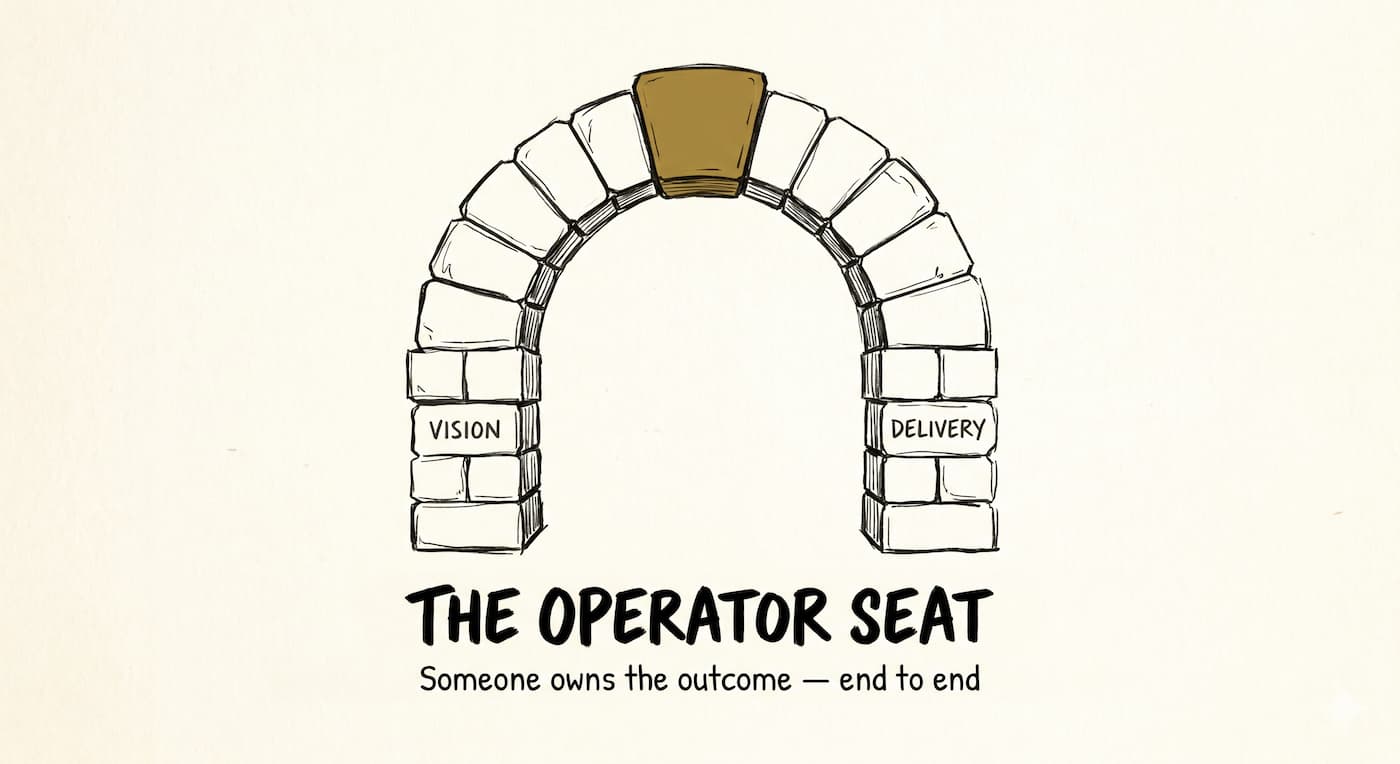
Last week's piece was about the Operator Vacuum — the gap between what an org decides and what it actually ships, with nobody on the hook for closing it end to end. A few people asked some version of the obvious follow-up: okay, so what goes in the gap?
Here's the answer — and the way I arrived at it is sort of the point.
A few months back I started a new engagement. The person I was taking over from was already transitioning out of the org — on the way to a new job, doing the decent thing and handing off what they could. What I got was a stack of recurring meetings, a folder of spreadsheets, and decks providing various views of what was going on in the org.
For the first few weeks, the job was about those artifacts: showing up to the meetings, keeping the spreadsheets current, answering the "can you check on X" messages. If you'd asked me to describe the role in week two, I'd have called it glorified admin. Useful, maybe. Strategic, no.
The Job Nobody Posts
This is what an empty Operator Seat looks like from the inside. Last week's piece named the gap. The Operator Seat is what's supposed to sit in the gap — the thing that takes what leadership decided and turns it into what a team actually does this week, then reports back up so leadership knows the loop closed.
When that function doesn't exist, nobody experiences it as "we're missing a role." There's no req that says "wanted: the person who connects what leadership decided in March to what the team is shipping in June." The org doesn't have a hole shaped like that, because nobody designed the role in the first place. What it has instead is a pile of tactical requests that all, traced back far enough, come from the same gap.
So the seat doesn't announce itself. It shows up as "can you sort out why these two teams think they own the same project," or "this report needs to make sense before Friday," or "I don't have visibility into X and that's a problem." Each one looks like its own small fire. None of them come with a note saying this is happening because nobody owns the thing that would prevent it.
Same Portfolio, Different Lens
I spent the first couple of months doing exactly what was asked — chasing the report, untangling the duplicate project, getting two groups talking about the thing they were both already doing. Tactical work, one request at a time.
But as things progressed, I started noticing the patterns. My role at this org sat in strategy and operations — I'm not building the product, I'm managing the portfolio of work around it. So this wasn't "we don't have a strategy" or "the team isn't working hard." Both of those were true, and neither was the problem.
What I kept running into instead: different parts of the business have a different lens into the same portfolio of work, and each one was building its own view to answer its own question — independently, in a silo. Finance is asking "is this funded and on track." Leadership is asking "how does this connect to the bets we made." Stakeholders are asking "what's the status, what's this actually worth." The teams doing the work are asking "what do I build this week." Every one of those is a legitimate question. None of them had a shared answer to start from, so each group went and built its own.
Nothing was shipping wrong, exactly. Nothing was late in a way you could point to and call a failure. What was actually happening was slower and harder to see: every one of those silo'd views was its own layer of admin — its own tracker, its own status meeting, its own version of "the numbers." Multiply that by however many lenses are looking at the same portfolio, and you get an org that isn't shipping the wrong thing — it's shipping everything more slowly and more expensively than it should, because a good chunk of everyone's time is going into independently re-deriving a picture that should only need to exist once.
I was brought in to fix one of those views — the strategy-and-ops one. But a fix to my corner that doesn't account for the other lenses isn't a fix. It's just one more silo'd view, mine this time. If I'm going to do this in a way I'd actually stand behind, it's not "build a better dashboard for one view." It's the system.
The Seat Was Empty Before I Sat in It
When I finally said all this directly — in a 1:1, after three months of tactical work — what came back wasn't surprise so much as relief.
My client had clearly sensed pieces of this already. You don't run an org this size without a feeling that something isn't connecting. But sensing it and having the bandwidth to step back and name it are different things, and they'd been too far inside the day-to-day to do the second one themselves. Saying it out loud wasn't news to them. It was confirmation — the thing they'd half-seen for a while was real, and someone was finally going to work on it instead of just feeling it.
Here's the part that took me longest to see, though: the role I was growing into wasn't created for me. It was already there, empty, before I showed up — which is why the person before me also got handed meetings and spreadsheets instead of a job description. They were already dealing with the Operator Vacuum, but hadn't named it, and hadn't recognized the Operator Seat they occupied.
The Operator Seat doesn't get discovered by looking for it. It gets discovered by doing the tactical work long enough to notice it's all the same job.
What This Doesn't Tell You
This particular version of the story happened to be about three lenses on one portfolio. I've watched the same underlying shape wear other costumes — a team buying new tooling for work that was never actually defined, a hire taking on a title without the function, a founder absorbing so much that they became the bottleneck. Tools, hiring, process, founder bandwidth — none of those are wrong diagnoses, they're just not the root one. Same question sits underneath all of them: who's translating the decision into the work, and reporting the work back as the decision? The next several pieces walk through a few of those other versions.
Here's the diagnostic, if you want to run it on your own org: pick one strategic priority — something leadership actually cares about this quarter — and try to trace a straight line from that priority to the specific work someone on your team is doing this week. Not "is it on the roadmap somewhere." A straight line: this priority → this initiative → this project → this sprint → this person's task list, with each link visible and agreed-on.
If that takes one conversation, you're fine. If it takes three people, two meetings, and someone saying "let me check and get back to you" — you've found the seat. It's empty.
What this doesn't tell you is who should fill it, or how. There's a version of this where you hire for it and the hire becomes another spreadsheet-keeper, and a version where the founder just keeps absorbing it. Both of those are their own conversations.
I write about this every week. Subscribe to Closing the Loop.