
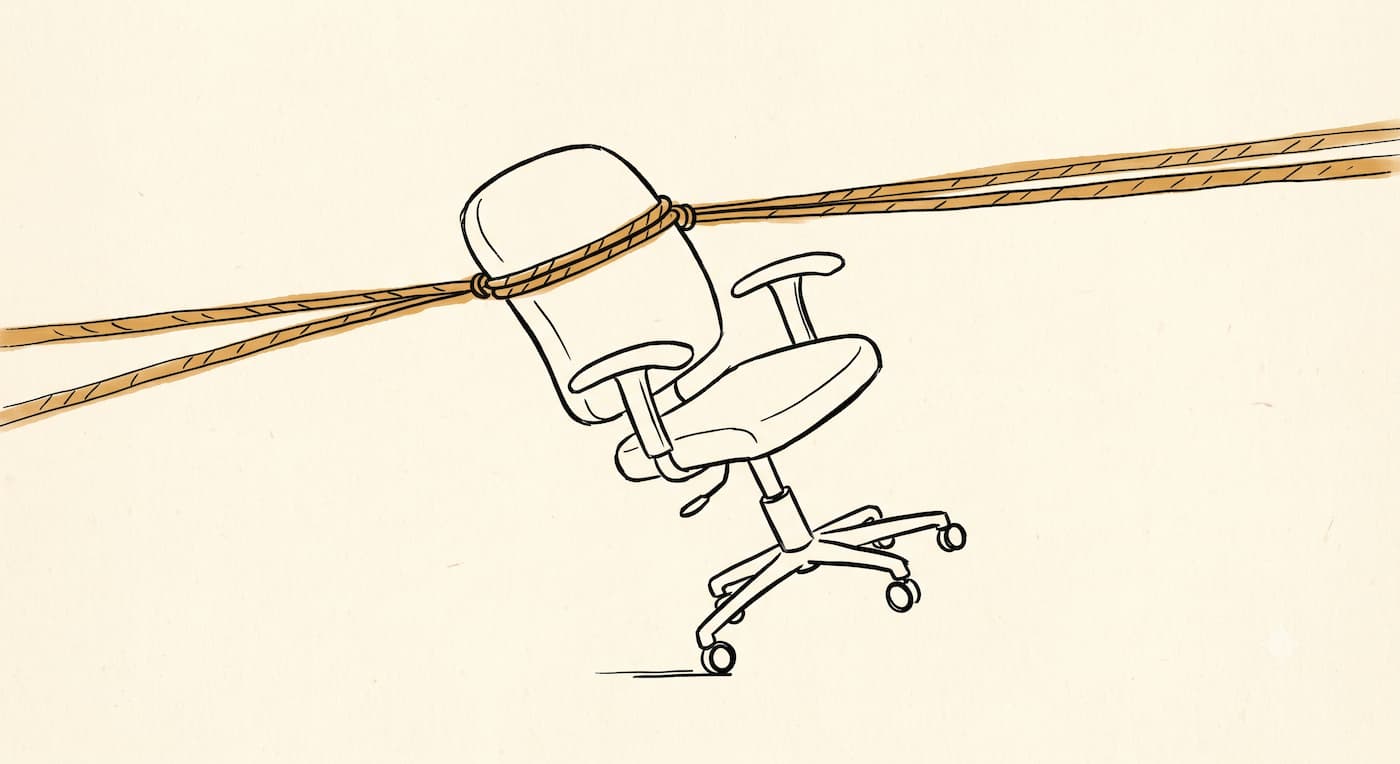
A replatform kicked off with a full team of developers and me, ready to build. None of us knew the product we were rebuilding — not the developers, not me. The founder did. He'd built the original version himself, years earlier, so he opted to fill the PM role personally. He'd already used AI to generate a full set of specs off the existing product, which meant we could skip the weeks it normally takes to ramp people up on what v1 actually did. Start building immediately, agentically, and learn the product as we went.
It looked like the fast path. It was the setup for an eight-week project that ran eight weeks late.
The Trap That Diagnoses Itself
This is what the Founder Bottleneck usually looks like at the start: not neglect, efficiency. The founder knows the product better than anyone, so putting themselves in the seat seems like the obvious move, not a mistake. Nobody sits down and decides to become a single point of failure. They decide to save two weeks, or a line item on a budget that doesn't have room for one more.
What makes this trap different from the Tool Trap, the Hire Trap, and the Process Trap is that the person causing it usually diagnoses it correctly, eventually, and nothing changes anyway. That's not denial. It's that the thing they've named accurately isn't a discipline problem. It's a seating problem, and you cannot out-discipline a calendar that has two full-time jobs competing for it.
The Founder Bottleneck is the one wrong fix where the person causing it can name it perfectly and still not fix it.
What the Founder Couldn't Un-Delegate
The specs existed, but he hadn't reviewed them himself before we started. The plan was that he'd review them as we built — catching anything the AI-generated draft got wrong against v1 before it shipped. That review was the one piece only he could do, because he was the only person who actually knew the original product well enough to spot when a spec had drifted from it.
A few weeks in, an urgent client matter pulled him back into running the business, which is what running a business does — it doesn't ask permission first. The human review stopped happening. I couldn't catch what he was missing, because I didn't know the product either, and I was stretched too thin across the rest of the program to dig into product-level detail I had no context for. Specs that looked reasonable on their own kept drifting further from what v1 users actually relied on, for weeks.
The Gate That Should Have Existed First
We righted it with a series of gates checking every stage of the build against v1 before it advanced — a process we should have had on day one. It worked, once it existed. By the time it was in place, an eight-week project had become sixteen.
My read on it, looking back, is that bringing me in two weeks earlier would have caught this before it cost anything. I'm fairly confident he sees it the same way — we're usually well aligned on things like this — and my guess is budget had more to do with the original setup than anything else. Sometimes none of the options in front of you are actually good ones. An outside operator, two weeks before the team had shipped a line of code, is a real cost you can see coming. Eight extra weeks and a partial rebuild is a cost too. It just isn't on anyone's invoice yet when you're the one deciding.
Penny wise, pound foolish — and an easy trap to fall into when only one of those costs is visible at the time you're choosing.
The Tell Isn't Speed. It's Who's on Critical Path.
If you want to know whether you're the bottleneck, don't look at how fast decisions move. Look at how many stop entirely the moment you're unavailable. Pick the thing only you review right now, and ask what happens to it if you disappear for two weeks. If the honest answer is "it waits" or "it gets built wrong without anyone noticing," you're not leading that piece of the company — you're its single point of failure, in addition to everything else you're already doing.
What This Doesn't Fix
This wasn't a founder with his head in the sand. He owned the miss the moment it surfaced, no prompting needed. That good-faith call still isn't the thing to fix — the fix isn't "review more diligently" or "protect more focus time." It's that the review should never have depended on one person's calendar surviving a business emergency intact. AI doesn't change this — it just speeds up the part that was never the actual risk.