
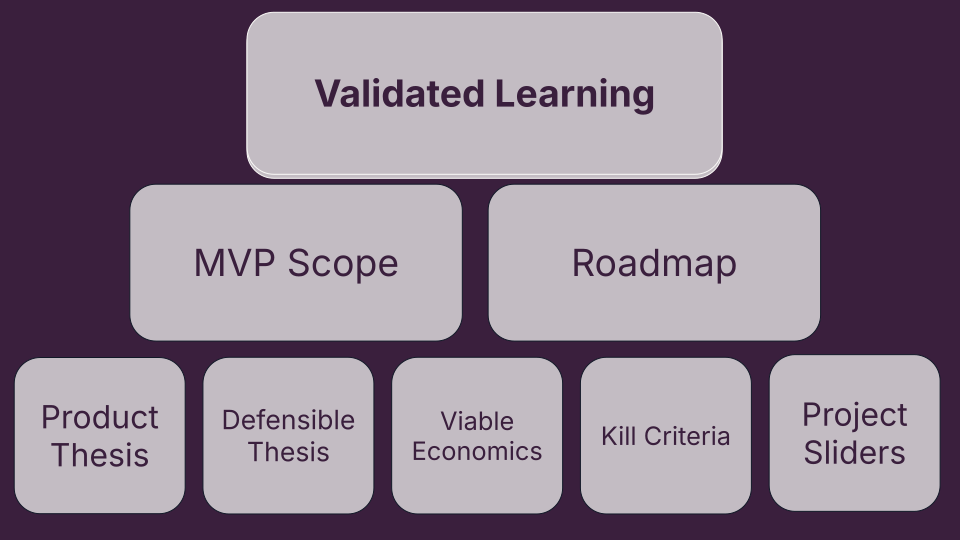
Over the last two months, we’ve systematically stripped the vanity out of your 0→1 build.
We defined what actually makes a thesis defensible (Part 1), stopped letting polite market feedback act as validation (Part 2), and faced the reality that your business model and distribution channel must be considered up front (Part 3). We learned that you cannot define an MVP until you explicitly define what failure looks like (Part 4), and discovered that setting project sliders—strict guardrails around time, budget, quality, and scope—is the only honest way to manage risk (Part 5).
We cut scope down to a single, end-to-end flow to prove the core concept (Part 6), and finally built a roadmap based on a sequence of strategic learning hypotheses, not just a list of features to ship (Part 7).
If you did the work, your foundation is solid. You know what you are trying to learn—and you have a sequence of strategic bets mapped out to prove it.
So you hand the roadmap to the team. The tickets get written. The sprints begin. You check the burndown charts, and velocity looks fantastic.
But as the weeks roll by, an unease settles over the room.
"We’re moving fast, but things aren’t compounding.”
That is usually how it gets described in board meetings and executive 1:1s. Teams point to velocity metrics and a fully loaded roadmap to prove that execution is happening. But underneath the momentum, the unease grows.
It is much easier to blame a lack of compounding value on execution or market timing than to admit the truth.
The Anatomy of Drift
Somewhere in the excitement of building and shipping, the original thesis got lost. You forgot about your project sliders. Or maybe you're hitting your "kill criteria," but instead of recognizing it as a signal to pivot, you try to "fix it" by building more features.
You don't fail in a massive explosion. You drift. You throw good money after bad, building continually on top of unchallenged assumptions and treating your initial roadmap as a guaranteed path to success rather than what it actually is: a learning hypothesis.
In early-stage builds, product-market fit isn't a threshold you cross and lock in forever. It is incredibly fragile. It emerges from a specific context and can evaporate just as quickly if your product drifts away from the core problem you set out to solve.
The Riker to Your Picard
We didn't spend the first seven parts of this series doing foundational diligence just to write it down and ignore it. That foundational work wasn't just to get you out of the gate—it is your playbook. It is your trusty sidekick, your #1 - helping you remain nimble, hold yourself honest, and see pivots coming before you hit a wall.
If you want to catch the drift before it eats your runway, you have to force deliberate course-correction. This week, pull up your current roadmap and ask your team these three questions:
- Are we still honoring our project sliders? Back in Part 5, you made tradeoffs across time, budget, quality, and scope. If you prioritized time-to-market but the build is three months behind, stop the line. You have to ruthlessly cut scope to realign with your original constraint.
- Is what we built actually working? Not "did it ship without bugs?", but "is it solving the problem we hypothesized in Part 1?" Look back at your defined success and kill criteria. If the hard data doesn't show users engaging with the core utility, do not advance the roadmap.
- Are we ready to pivot? If the signal tells you your hypothesis was wrong, do you have the organizational readiness—and the lack of ego—to change direction?
Most teams measure momentum by asking what they need to ship next.
Winning teams measure momentum by asking what they need to learn next.
The Fundamentals Don't Change
I've had several founders tell me, "I don't know what I don't know." That's exactly why I wrote this series - as a way to help you see around the corners before you hit them. I've been through this a few times, and hopefully, you can benefit a bit from my experience.
This series was meant to give you an idea of what could be down the road, but let's be clear: building a 0→1 product is not easy-peasy just because you followed a system. I'd be lying to you if I said that. It's the Wild West out there. Not only from a "move fast" perspective driven by your investors and the competitive landscape, but the technologies we rely on are shifting beneath our feet as well. The tools we use today to realize our vision will probably look completely different six months from now.
Because of that chaos, it's more important now than ever to keep the fundamentals close at hand and top of mind. I've been building products for 25 years. And I can tell you the fundamentals haven't changed. Only the tools we use to realize them have.
Stay Grounded
You’ve constrained your scope. You’ve named your risks. You’ve built the foundation to stay nimble, but you can still feel the drift, and the cost of delay is undeniably real. This is usually the point where teams fall into one of two camps.
Some realize that seeing the problem clearly isn't the same as knowing how to solve it.
But others—often the ones moving the fastest—don't realize they've drifted. They mistake a decision problem for an execution problem, panic-building features and throwing good money after bad to try and outrun a broken strategy with raw velocity.