
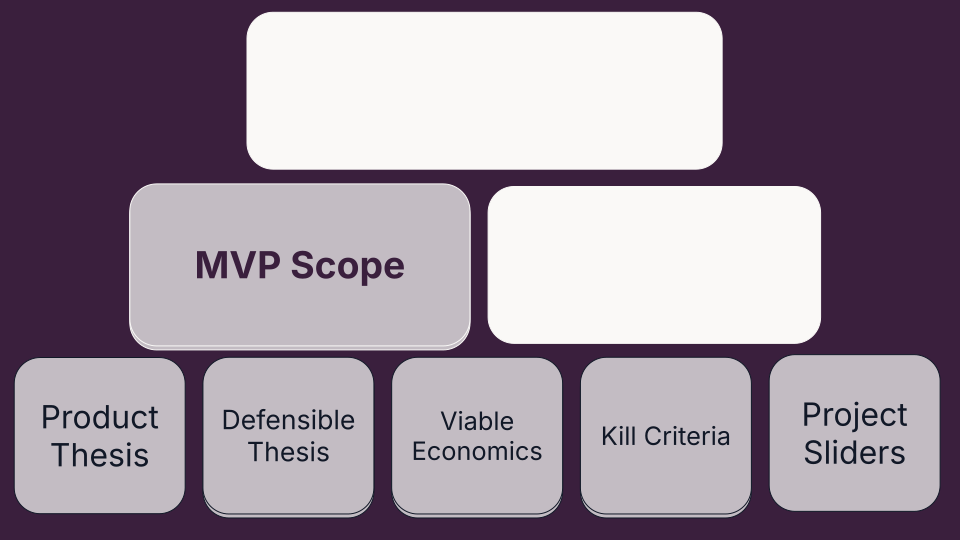
Over the last five weeks, we’ve laid the groundwork for this moment. We replaced vague optimism with a defensible thesis (Part 1). We stopped treating polite conversations as validation (Part 2). We stared down the business model (Part 3), defined what failure actually looks like (Part 4), and accepted that risk and tradeoffs (Part 5) are the only honest way to scope an MVP.
And yet, you’re probably staring at a whiteboard (or a Jira backlog) filled with features that have nothing to do with any of that.
Advanced filtering. PDF exports for reporting. Multi-user permissions. A Slack integration. "Dark Mode" (because a developer insisted). And, of course, the inevitable "Invite a Friend" feature because viral loops are cool.
It feels good. It feels like a product. You start throwing SWAGs at the effort—a week for this, two weeks for that—and suddenly your 3-month launch timeline looks more like 9 months.
Panic sets in. You start negotiating with yourself. "Maybe we don't need PDF export for V1, just CSV." "Maybe multi-user permissions can be manual."
You are solving the wrong problem. You are trying to build version 0.1 of everything, instead of version 1.0 of the most important thing.
The Myth of the "Minimum" Component
Most founders treat an MVP like a stripped-down version of the final vision. They take the "full" product and start cutting features until it feels uncomfortable but shippable.
That is how you build an inadequate product that takes too long.
(And by the way—if you are building basic things like authentication or simple dashboards from scratch in 2026, stop. Use off-the-shelf components. But even configuring those takes time you might not have.)
The market doesn't care about your feature list. They don't care about your parity with competitors. They care about solving the problem defined in your thesis.
And usually, solving that problem requires exactly one core flow.
If you cannot define the single, unbroken sequence of actions that proves your thesis correct—without "settings," without "profiles," without "nice-to-haves"—then you do not have a product. You have a collection of features looking for a purpose.
Use Your Foundation as the Filter
This is where the work we did in Parts 1-5 becomes your weapon. You aren’t guessing anymore; you have a rubric to make ruthless decisions.
Start by brainstorming everything you want the product to do. Get it all out on the whiteboard. Every verified requirement, every "cool idea," every table-stakes expectation.
Now, use your foundation to sort them into two buckets:
- Differentiators: These features must pull directly from your Thesis (Part 1). These are the absolute must-haves that prove your unique value proposition. If you don’t build these, you are just building a worse version of something that already exists.
- Table Stakes: These are the features necessary largely because others have them (login, profile, settings). They are parity features.
Here is the trap: Most founders think "Table Stakes" means "Required for Launch." It does not.
One Flow to Rule Them All
To find your true MVP scope, set aside the buckets for a moment and ask yourself this:
If I could only build one flow—one single path from A to B—that would prove my thesis is correct, what is it?
If you are building an AI scheduling assistant, the flow isn't "Sign up -> Connect Calendar -> Set Preferences -> Dashboard." The flow is: "Receive email -> AI understands intent -> Meeting is on calendar."
Everything else is noise.
If you are building a marketplace, the flow isn't "Browse listings -> Filter by price -> View profile -> Message seller." The flow is: "Buyer sees item -> Buyer pays -> Seller ships."
The Kill Step
Now, look at that One Flow and bring your sorted buckets back.
- From the "Table Stakes" Bucket: Does this feature block the One Flow? If not, kill it. (Do you really need a "Forgot Password" flow for 10 beta users? No. You can reset it manually in the DB. Kill it.)
- From the "Differentiators" Bucket: Does this feature enable the validation of your thesis within the One Flow? If yes, keep it. If it's just "cool" but doesn't serve the core loop, kill it.
- Use Your Risk Analysis (Part 5): When you have two features fighting for survival, use your Project Sliders as the tie-breaker. If you prioritized "Speed to Market" over "Scope," kill the feature that requires a complex backend.
Why This Is So Hard
Startups die because founders choose comfort over clarity.
It is comfortable to build a Settings page. It is comfortable to build a nice onboarding wizard. These are solved problems. You know how they work. They make you feel like you are "building a product."
It is terrifying to build only the core value prop. Because if that one flow doesn't work—if users walk through it and shrug—you have nowhere to hide. You can't blame the lack of "dark mode" or "better filters."
You have to face the market naked.
Stop Negotiating With Scope
When you focus on the One Flow, scope creep disappears. "Wouldn't it be cool if..." is answered instantly: "Does it block the One Flow?" No? Then it's gone.
The cost of delay is the silent killer of startups. Every week you spend building "table stakes" features that don't support your core hypothesis is a week you aren't learning if your business is real.
You don't need a roadmap. You need a single working path through the jungle.
Once you have that—and only once you have that—you earn the right to build the rest.
You Shouldn't Do This Alone
Pruning a product vision down to a single flow is agonizing. You are too close to it. Everything feels essential. Everything feels like a "must-have."
That inability to cut is usually a symptom of a deeper uncertainty about what actually drives value.
If you are looking at your feature list and feeling that creeping sense of "we need all of this," stop building. You are about to burn 6 months of runway on features that don't matter.
I work with founders to ruthlessly scope MVPs down to the decisions that actually drive the business. If you want to ship the right thing instead of everything, let's talk.