
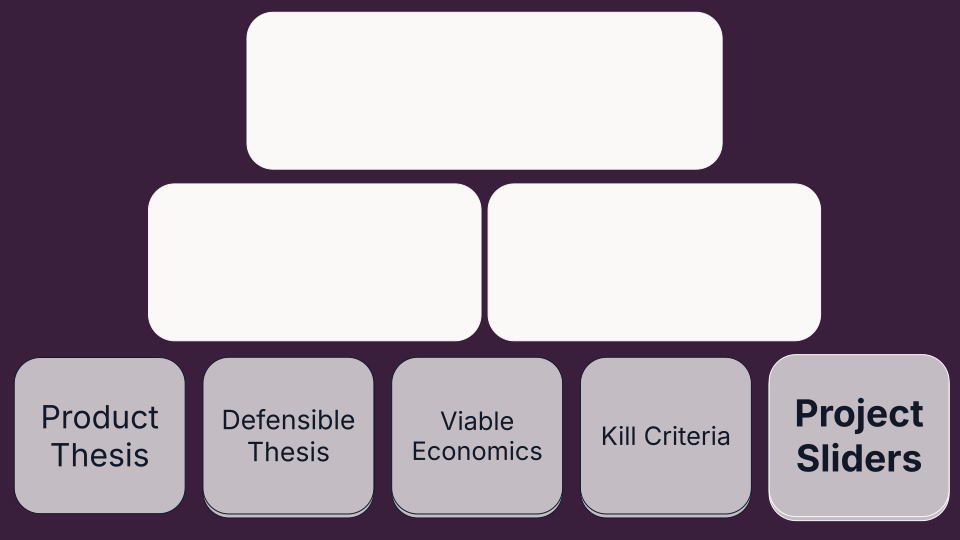
We’ve spent the last few weeks building the foundation. We ditched the hunches for a defensible thesis, realized that casual conversations aren’t validation, and vetted the economic viability of the business before writing code. Last week, we even defined the "kill criteria" that determine if your product deserves further investment.
But there is one more foundational piece to put in place before we can define a launch scope and start building. We need to talk about the stakes you’re actually playing with.
The "Delivery Slip" Mirage
"We have a clear roadmap, but delivery keeps slipping."
That’s how most founders describe the month leading up to a launch. It’s the standard diagnosis for why the feature list is still growing while the deadline is drifting. You assume it’s an execution problem—the engineers are moving too slow, or the PM is dropping balls.
That’s a comfortable framing because it implies you just need a better process. But let's be honest: your delivery is fine. Your alignment is broken. You are trying to build the ideal version of your vision on Day One because you’re afraid that if you don't, you won't have a business.
Refusing to choose is far more dangerous than moving slowly.
In this stage, scope works best when viewed as a series of expensive bets designed to buy you information, rather than a fixed to-do list. If you treat your list of features as non-negotiable, you've already lost. Most overthinking in this industry is just fear wearing professional clothing. Real leadership is the courage to decide where you are willing to fail.
We call these your Project Sliders: Budget, Scope, Time, and Quality.
Most founders subconsciously believe they can have all four. It’s a strategic hallucination. If you haven't explicitly ranked these, the universe will rank them for you—and usually, quality and time are the first things to get sacrificed on the altar of a bloated feature list.
Understanding the stakes
Alignment on these sliders is the prerequisite for everything that follows. Without it, you are making decisions in a vacuum. You need to know if "Time" is your hard constraint because of a board deadline, or if "Quality" is your differentiator because you’re entering a crowded market where "best-in-class" polish is the only way to get noticed.
This alignment informs how you prioritize your roadmap against the real risks:
- Market risk: Does anyone actually want this?
- User behavior risk: Will they change their habits to use it?
- Technical/AI risk: Can we actually build the intelligence without hallucinations eating the budget?
- Operational & Regulatory risk: Can we support it, and is it legal?
If your initial build doesn't expose your biggest risk in the first month, you're building a monument to your assumptions instead of a product. The momentum you feel from shipping a lot of stuff is often just the sound of you burning runway to avoid an uncomfortable truth.
Choosing your build's Operating System
Before you cut another ticket, you need to choose the "Operating System" for your build. This goes beyond software choice; it's a cultural commitment to how you handle stakes.
If your sliders indicate that Time or Budget is the hard limit, you operate in a Fixed Time model. You set a hard "appetite" (e.g., 4 weeks). If the work isn’t done, you stop. You use the "scope hammer" to ruthlessly cut anything that isn’t the primary success path. You ship on time, even if it's "ugly" behind the scenes.
If your differentiator is Quality or Scope, you move to a Momentum-Driven model. You focus on craft and accept that the date might slide to ensure the initial experience is exceptional.
If you haven't explicitly chosen one of these based on your team’s seniority and/or your investor's expectations, you are operating in a state of expensive ambiguity. Everything becomes a priority, and therefore nothing is.
The Slider Alignment Test
Try this today: Ask your Lead Dev and your Lead Designer to rank those 4 sliders in order of importance. Then you do the same.
If your rankings don't match, you've found the source of your "slipping delivery." It's a math problem, not a mystery.
This test increases clarity, but it also creates tension. It forces you to name what you’re willing to sacrifice. Most teams get stuck here because being wrong feels expensive. This is usually the point where founders ask me to sanity-check their thinking—not because they don’t understand the framework, but because they need a second set of eyes to spot the professional overthinking that’s eating their runway.
And with that - the final piece in our foundation is laid. Next week, we'll take these tradeoffs and use them to perform a "Ruthless Scoping" session. We’re going to find the one end-to-end user flow—the only one—that justifies your existence.