
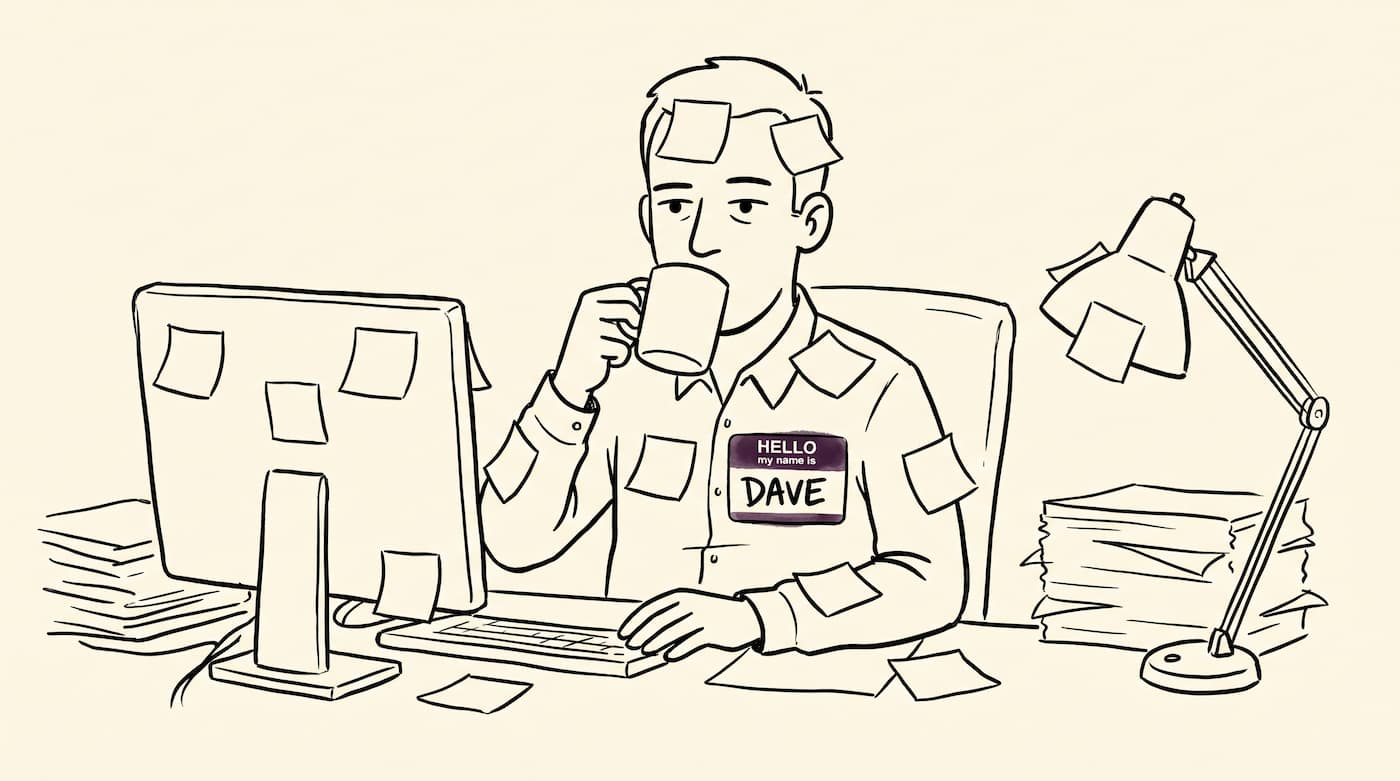
Someone on r/Leadership asked a really good question a few weeks back: "What's the best example you've seen of a process that turned out to actually be a person?"
Most of the answers were about Dave. The OP set it up himself: "one experienced person takes a day off and suddenly everyone discovers how much of the operation was actually stored in Dave." One commenter confessed he'd been the Dave on a legacy stack for years: "every time someone asked how the cron jobs worked, i'd fix it myself because explaining it took longer than doing it." Another coined a unit of measurement for it: "every time you get Dave'd."
Every company has a Dave. In a company under a hundred people, I'd bet money the first Dave is the founder. You're the one with the full machine in your head, so every small but non-trivial call routes back to you, and Dave never gets a day off. That's the Founder Bottleneck, and the thread is a pretty good tour of it from the outside.
The fixes people offered were all some version of writing it down: a wiki, quarterly SOP updates, a tabletop exercise where you pretend Dave is out. The OP saw the problem with that before anyone else did: "Document everything and you create bureaucracy. Document nothing and you create dependency." Then he wrote the line I think matters most, and the thread walked right past it:
"Each department can have a perfectly reasonable process on its own, and the mess is sitting between them."
That space between the departments is the Operator Vacuum, and it's where Dave lives.
Dave's Standards Keep Moving
Some of what's in Dave's head really can go in a doc. Turn the recurring yeses into rules, let routine work go ahead without waiting for a sign-off, and you'll get back more of your week than you expect. Do that first.
The rest of it doesn't survive being written down. A senior PM on r/ProductManagement described what it's like to work for a founder who holds all of it in his head: the team scopes something, writes a proper brief, gets an approval in principle, and only then do the founder's real preferences come out. Sometimes the document is too complex, other times it isn't detailed enough. "Hard to calibrate to a standard that moves."
If you've worked at a startup, you probably felt that one in your stomach. I did.
The standard moves because it's judgment, and judgment updates. What's in Dave's head is a running read on what you told the board, which customer is about to walk, and how much risk you can stomach this quarter, and that read changes every week. A doc freezes it on the day you wrote it.
So the judgment has to land in a person, and that's where it gets scary.
Why It Feels Like Jumping
On my last post, Catarina von Maydell, who works with engineering leaders, put her finger on it. Leaders tend to treat handing over decisions as a binary: "either you have control, or you don't." If it really were binary, handing someone your calls would mean handing them your company. No wonder people stall.
The fear isn't irrational, either. Your name is on the outcome. I have my own guesses at what sits underneath it: they'll make a call you wouldn't have made, you'll lose your feel for your own company, the team will go around them and straight back to you, or you'll pick the wrong person and find out six months too late. I'm genuinely not sure which of those is the big one. More on that at the end.
Here's a test for where you stand. Give Dave two weeks off the grid. No phone, no Slack. Who is making decisions? Anybody? Or does everything grind to a halt and wait for you to come back? If the honest answer is that it waits, the judgment hasn't gone anywhere yet, no matter how many docs you've written.
Same Operator, Three Different Endings
At Azrieli Digital I was the first hire, period. The CTO brought me in before anyone else and we built the team from there. We evolved into a truly well oiled machine - and for a long time I couldn't put my finger on why. I've tried to bottle it on other engagements and it has never come out quite the same.
I think I finally get it. The CTO and I were very, very tightly aligned. He told me everything, and he let me make calls. He showed a lot of faith and trust in me from the get-go. We really just, clicked.
I've had the other versions since. In one engagement I had all the information I could ask for and no clear authority to act on it, so the calls kept rolling back up to the founder anyway. In another, information stayed siloed and nobody, me included, could say what I actually owned. I never got anywhere there. I was the same operator in all three, and the results weren't close.
"Make It So" Only Works If Riker Knows the Plan
Nobody's asking you to give up the captain's chair. The idea is to put someone with a lot of flight hours in the first officer's seat (what I call the Operator Seat). Picard says "make it so" and Riker does, because Riker knows the mission, knows where the lines are, and the whole crew knows he speaks for the captain.
That's the difference between a first officer and a Dave: everybody knows what the first officer is allowed to decide.
From what I've seen, getting there takes four things.
Flight hours. This can't be their first rodeo. I honestly haven't found a way to make it a junior position. People early in their careers ask for permission, and they're being reasonable when they do. Someone with scar tissue is more comfortable asking for forgiveness, inside the lines you've drawn. If your first officer asks permission for everything, you haven't removed the bottleneck, you've added a step in front of it.
More transparency than anyone else gets. The board conversation, the runway, the customer who's wobbling. If you don't tell them, they can't make the call you would have made, because they're deciding with half the picture. This is the one founders push back on hardest.
Guardrails. Some calls should still roll up to you, and you get to say which. In practice the guardrails protect the most critical existential stuff. Stuff like legal and structural questions, for one: a founder I work with was bidding on a government contract through a joint venture, and how that joint venture was structured was his call, full stop, because it goes to the heart of what his business is. I couldn't make that one for him and I shouldn't have. Big money, for another. A $100-a-month tool is probably fine. At $500 a month and up, we talk, and the same goes for any budget exception. And strategic pivots: if an experiment suggests a different brand positioning might land better than the one we have, that's a conversation with the founder, not a call I make on a Tuesday.
It's up to you to decide where those guardrails lie. Everything else is fair game for the Operator Seat, and it's most of what normally piles up on a founder's desk. Engineering wants to roll back a release at 4pm on a Friday, and that release carries the feature you promised the board for Monday. The company doesn't likely live or die on that call, but there are a dozen like it every week, and together they're the death by a thousand paper cuts that splits a founder's attention day in and day out. Those are exactly the calls the Operator Seat is for.
The team hears it from you. Out loud. If you don't say it, people will route around your first officer and come straight back to you, and honestly, they'd be right to. A manager on r/managers wrote the best explanation I've seen: "Once I have no confidence that my manager is going to support me, I will verify it all in advance." Every one of those verifications lands back on Dave's desk.
Every one of those four costs you something. Flight hours cost money. Transparency costs privacy. Guardrails mean deciding ahead of time what you actually care about, which is harder than it sounds. And saying it out loud means you can't take it back without everyone noticing. I think that's why it's scary, and why so few founders do it well.
I've spent a lot of posts arguing that the judgment has to get out of your head. This time I'd rather hear from the people who would actually have to hand it over. If you run a company, whether you've tried this or not: what's the call you would never hand to someone else, and what would have to happen to change that? Dave deserves a vacation.